TWO:The French had always beheld with jealousy our possession of the island of Minorca, which had been won by General Stanhope in 1708, and secured to us by the Peace of Utrecht. That England should possess the finest port in the Mediterranean, and that so near their own shores, was a subject of unceasing chagrin. The miserable administration of British affairs, the constant attention to the interests of Hanover instead of our own, now inspired France with the resolve to snatch the prize from us. Great preparations were made for this object, and the report of these as duly conveyed to the English Ministers by the consuls in both Spain and Italy, but in vain. At length the certainty that the French were about to sail for Minorca burst on the miserable Ministers; but it was too late¡ªthey had nothing in readiness. The port of Mahon was almost destitute of a garrison; the governor, Lord Tyrawley, was in England; and the deputy-governor, General Blakeney, though brave, as he had shown himself at the siege of Stirling, was old, nearly disabled by his infirmities, and deficient in troops. What was still worse, all the colonels were absent from the regiments stationed there, and other officers also¡ªaltogether thirty-five!
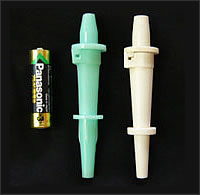
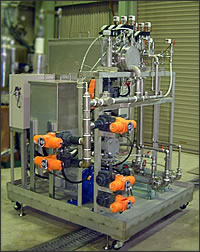
A hydrocyclone (liquid cyclone) injects treatment solution into stationary equipment to perform separation, classification, and concentration, and is an innovative separator with a very simple structure and no drive unit.
Structure of a hydrocyclone (liquid cyclone)
A suspension containing fine particles of several micrometers or more is supplied to a cylindrical container circumferentially at high speed. And as a result it starts to rotate and a centrifugal force is generated. At this time a gravitational acceleration of several tens of thousands of G is generated in the circumferential direction, and thus leading to fast sedimentation and concentration of the fine particles. The separated concentration can be freely selected by changing the supply rate (supply pressure and flow rate) and the flow ratio of the outlet. Our hydrocyclone (liquid cyclone) was designed and manufactured to classify and concentrate fine particles, and so has a small element.
THREE:THE "FIGHTING T¨¦M¨¦RAIRE" TUGGED TO HER LAST BERTH TO BE BROKEN UP, 1838.
- Equipment costs can be reduced.
- Operating costs can be reduced.
- Maintenance costs can be reduced.
- Any change in raw material and product can be easily addressed.
- Large amounts can be treated in a small area.
- Separation and cleaning are easy because of the simple structure.
- Simplified control
- This equipment can be operated in synchronization with external devices.
- Alarm and interlock mechanism.
THREE:There was one irritating circumstance connected with the Emancipation Act: the words, "thereafter to be elected," were introduced for the purpose of preventing O'Connell from taking his seat in virtue of the election of 1828. The Irish Roman Catholics considered this legislating against an individual an act unworthy of the British Senate¡ªand, as against the great Catholic advocate, a mean, vindictive, and discreditable deed. But it was admitted that Wellington and Peel were not to blame for it; that on their part it was a pacificatory concession to dogged bigotry in high places. Mr. Fagan states that Mr. O'Connell was willing to give up the county of Clare to Mr. Vesey Fitzgerald, and to go into Parliament himself for a borough, adding that he had absolutely offered 3,000 guineas to Sir Edward Denny for the borough of Tralee, which had always been regularly sold, and was, in point of fact, assigned as a fortune under a marriage settlement. Mr. Vesey Fitzgerald, however, rather scornfully rejected the offer, and Mr. O'Connell himself appeared in the House of Commons on the 15th of May, to try whether he would be permitted to take his seat. In the course of an hour, we are told, the heads of his speech were arranged, and written on a small card. The event was expected, and the House was crowded to excess. At five o'clock the Speaker called on any new member desiring to be sworn to come to the table. O'Connell accordingly presented himself, introduced by Lords Ebrington and Duncannon. He remained for some time standing at the table, pointing out the oaths he was willing to take, namely, those required by the new Act, and handing in the certificate of his return and qualifications. His refusal to take the oaths of supremacy and abjuration having been reported to the Speaker, he was directed to withdraw, when Mr. Brougham moved that he should be heard at the bar, to account for his refusal. But on the motion of Mr. Peel, after a long discussion, the consideration of the question was deferred till the 18th. The Times of the next day stated that the narrative of the proceeding could convey but an imperfect idea of the silent, the almost breathless attention with which he was received in the House, advancing to and retiring from the table. The benches were filled in an unusual degree with members, and there was no recollection of so large a number of peers brought by curiosity into the House of Commons. The Speaker's expression of countenance and manner towards the honourable gentleman were extremely courteous, and his declaration that he "must withdraw," firm and authoritative. Mr. O'Connell, for a moment, looked round as one who had reason to expect support, and this failing, he bowed most respectfully, and withdrew.
- Classification and concentration for the manufacture of inorganic powder materials
- Classification of ceramic materials
- Removal of fine particles, including iron powder
- Removal of fine particles from pigments
- Removal of fine organic particles from solvents
- Separation of starch and yeast
- Removal of fine particles from high-temperature strong acid solutions
- Removal of fine particles from low-temperature solutions